
Module Six: Post Build
Contents
Video
Better Building Banter
Introduction
Future Thinking
Building for Longevity
LCAs
What Happens Post-Build
Renovations and Maintenance
Build for Deconstruction
Reuse of Materials
Resources/Links
Professional Development Points
Quiz
Video
Better Building Banter
Tune into a recording from a Better Building Banter: Beyond the Build held on 7 July 2026 at Ground Up Brewing to hear about what it means to build with longevity in mind — from the renovation coalface, where the consequences of short-term decisions show up fast, to a new framework for thinking about buildings as assets that can be maintained, improved, and kept out of the skip.
Featuring speakers Livia and Darren Warren, and Hamish Grotrian of Pavilion Architecture, each speaker offers different industry perspectives about how to get a building performing well so it lasts, and what it costs over its lifetime when we take care for and invest from the outset.
Introduction
A building project isn’t complete once the build phase is finished. A building’s whole-of-life can be long and diverse. It can have multiple occupancies, uses, layouts, and renovations.
One of the biggest opportunities in the built environment is to keep buildings and materials in use for as long as possible. Rather than thinking of a building as something that will eventually be demolished, we should think of it as a materials library. Products like bathroom vanities, kitchen benchtops, doors, windows, and even structural elements such as timber framing may all have value beyond their first use if they are maintained, recovered and reused.
The best way to reduce end-of-life waste is to avoid reaching end-of-life in the first place. Extending a building's life through good design, quality construction, maintenance, renovation or adaptive reuse almost always has a lower environmental impact than demolition and rebuilding. When a building can no longer serve its purpose, recovering materials through disassembly or deconstruction should be prioritised.
The important thing is that these outcomes don't happen by accident. Decisions made during design and construction determine how easy a building will be to maintain, renovate, adapt or eventually deconstruct. Thinking about a building's entire life – from construction through to eventual reuse or deconstruction – helps reduce future costs, minimise waste, and preserve valuable resources.
In this module, we'll look at the key post-build practices that support a circular economy, including:
Building for longevity
Life Cycle Assessment (LCA)
Renovations and maintenance
Designing for disassembly and deconstruction
Material recovery, reuse and recycling
By considering a building's whole life – not just its construction – we can help create buildings that last longer, generate less waste and retain the value of the materials they contain.
Case Study: Explore the circular retrofit of Sydney's Quay Quarter Tower to see an excellent example of how extending the life of an existing building can significantly reduce environmental impacts.
Future Thinking
Yes, this module is focused on post-build. But the decisions that shape how well a building ages – how easy it is to maintain, renovate, adapt, or eventually deconstruct – are made long before post-build begins. Thinking about longevity, environmental impact of materials, and their disassembly or recovery at the design and construction stage is one of the most effective ways of setting a building up for a longer, low-waste life.
Building for Longevity
The first and most effective practice is building for longevity. New Zealand building standards aim for a 50-year lifetime – but really, we should be aiming much higher.
We can do this by choosing materials with longer lifespans, so they’re not in need of replacement every few years. Whether that's structural elements such as cladding and roofing, or interior products like carpets and bathroom faucets.
When choosing materials for a build, it’s worth weighing up the frequency and cost of maintenance and replacement, not just the price tag on day one. A building built with cheaper upfront materials can end up costing more over its lifetime.
Take cladding as an example. Common pine weatherboard comes in at around $110/m², compared to a stronger, longer-lasting option like spotted gum at around $250/m². The upfront cost clearly favours pine weatherboard. But looking at the two images below, by the time each reaches end-of-life, the pine weatherboard has likely cost more overall – due to its shorter lifespan and more frequent maintenance.
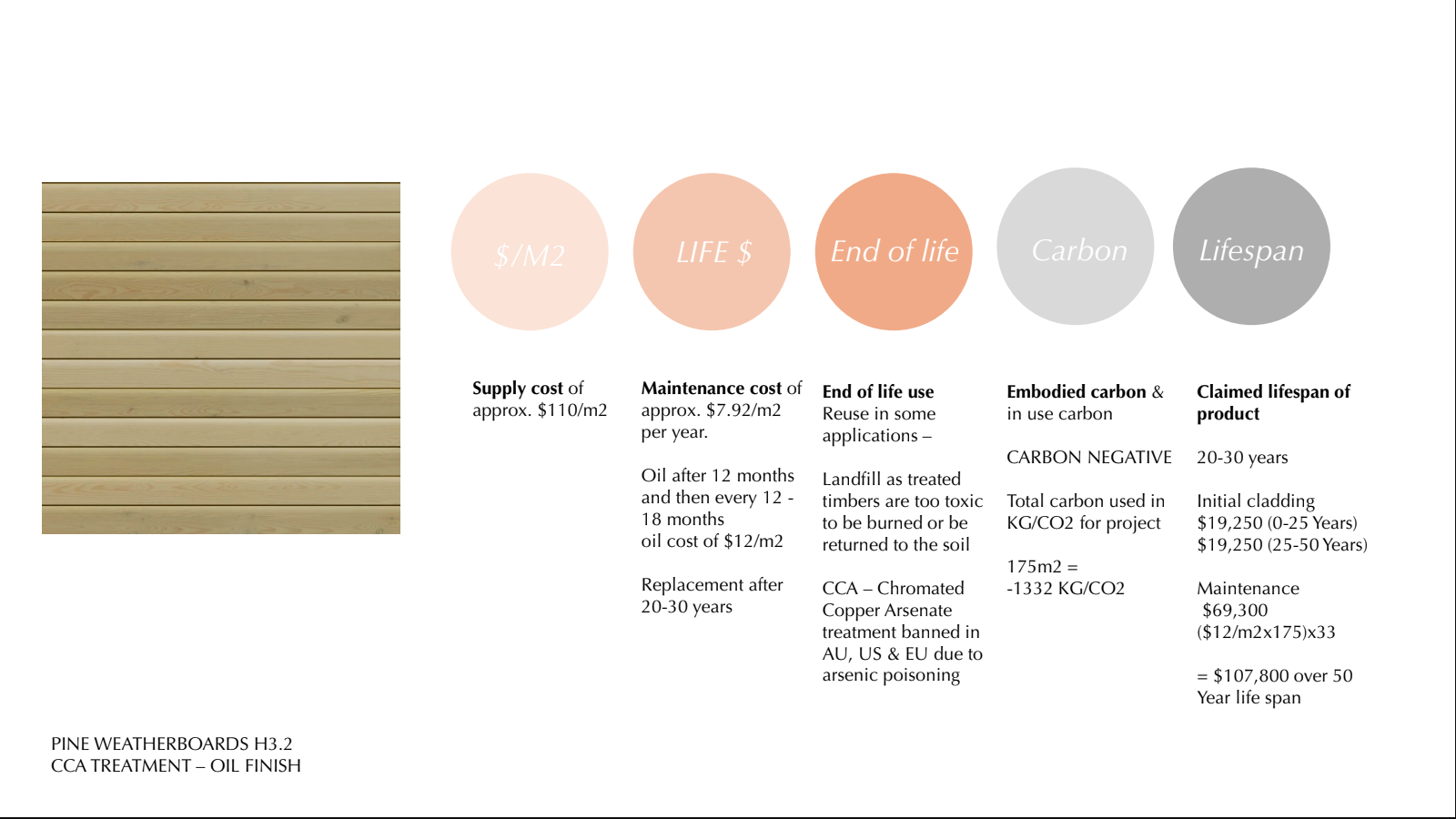
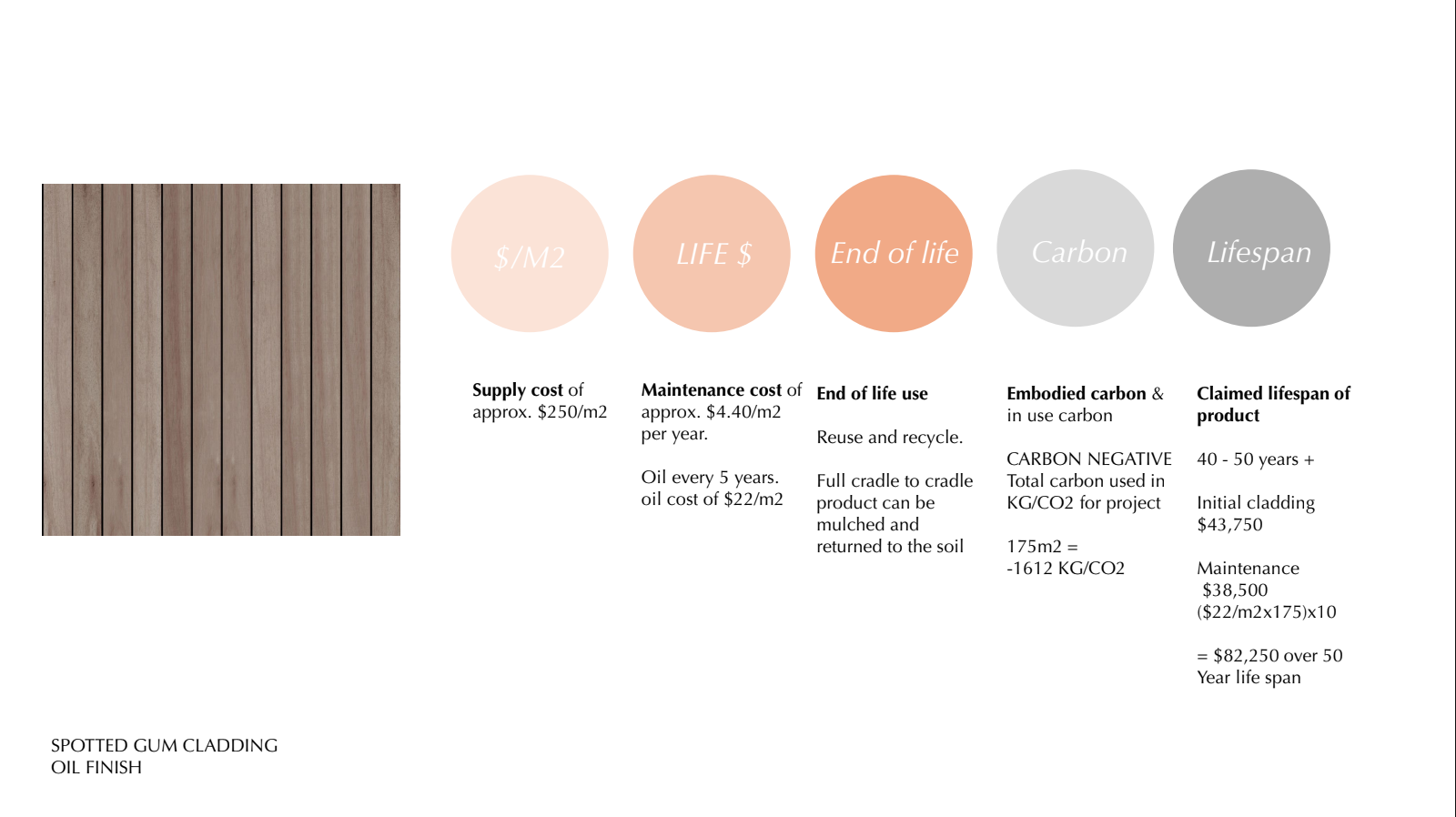
And these aren’t just financial costs. Materials with shorter lifespans and higher maintenance needs come with additional environmental costs too.
Material or product choice also shape end-of-life outcomes – whether something can be reused, recycled, downcycled, or whether it ends up in landfill.
That’s why it matters for everyone involved in a build – client, builder, supplier – to understand the full lifetime cost of a build, not just the upfront price.
Life Cycle Assessments (LCA)
Alongside planning for longevity, another useful tool to bring in early is Life Cycle Assessments (LCAs).
An LCA is a method for measuring the environmental impacts of a building or building product across its entire life – often described as “cradle to grave”.
“For buildings, this means tracking impacts across the entire lifecycle: from raw material extraction (cradle), manufacturing and fabrication, building operation, maintenance, demolition and end-of-life use (grave) of building materials.” Source: Hera - LCA Explained
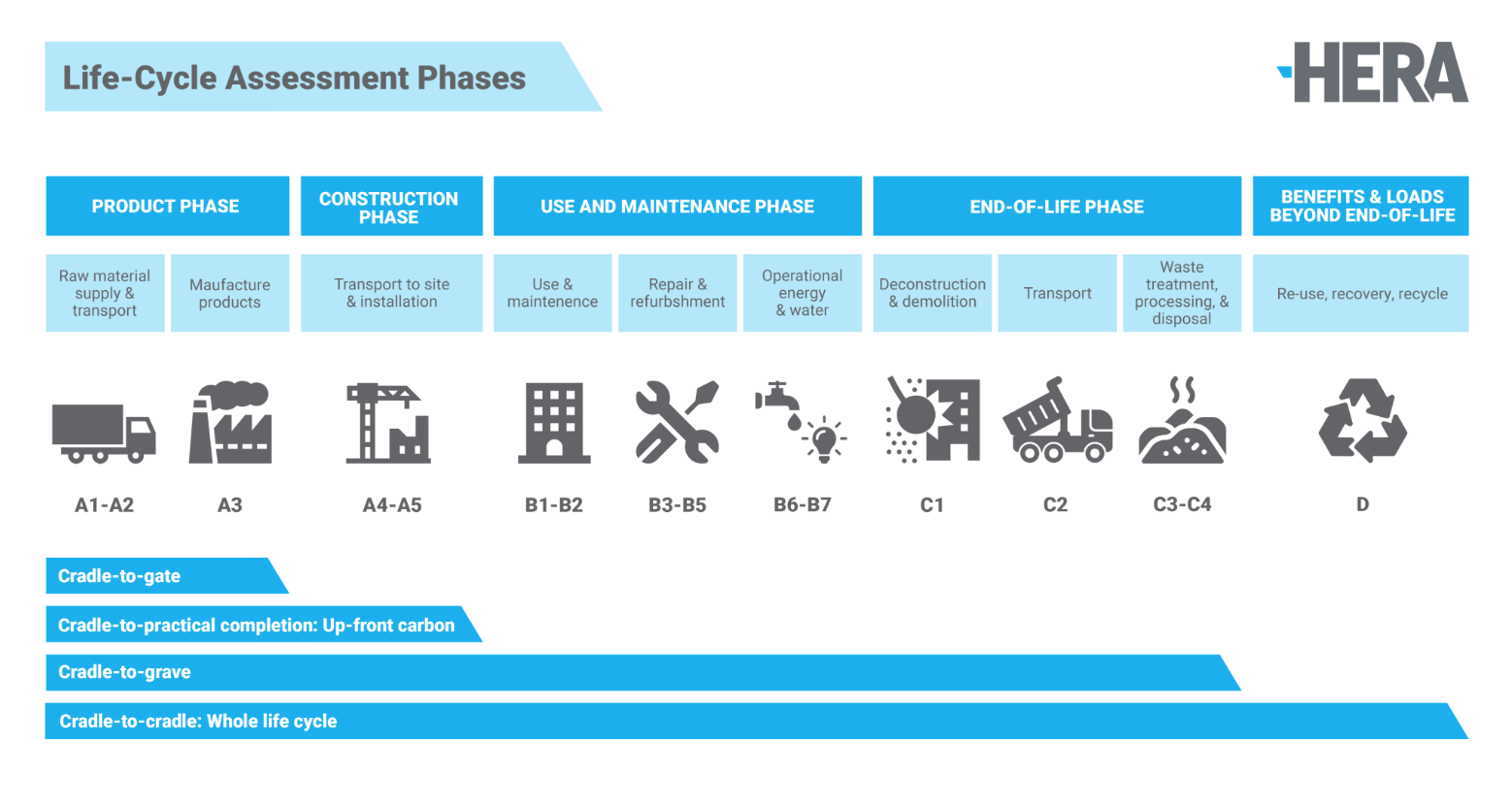
LCAs help identify where environmental impacts occur across a product, material, or building’s whole life. Understanding this helps everyone make more evidence-based decisions – reducing embodied and operational carbon, supporting sustainable procurement, and lowering whole-of-life environmental impacts.
*Note: Carbon is only one of many important measures within an LCA, other environmental impacts such as land and water contamination or natural resource depletion are also assessed.
Assessing these impacts gives everyone working on a project a clearer picture of what they're dealing with – because we can't improve what we don't measure. As LCA’s become more widely used, designers, builders, and clients are better placed to make informed decisions that reduce environmental impact across the built environment.
To understand the framework and guidelines of how LCAs works, take a look at the international ISO 14040/44:2006 Environmental Management standards for LCA:
There are also some great tools and resources to help put LCAs into practice:
LCAs help us understand the environmental consequences of the design decisions covered so far. They let designers and builders compare options, identify where the greatest impacts occur, and check whether strategies like building for longevity, choosing durable materials, or designing for reuse are actually making a difference.
What Happens Post-Build
There’s plenty that can be done post-build to help move towards a circular economy – building refits, material salvaging, and second-hand markets, to name a few.
But these later stages go much more smoothly if a building's whole life was considered from the beginning. We know buildings will go through renovations and eventually reach end-of-life stages – so preparing for those stages early makes things easier for everyone (and everything) when the time comes.
Renovations and Maintenance
Building renovations are an important part of a building’s life cycle. They can help prolong a building's life, improve its functionality, and keep it in use for longer – ultimately ensuring it stays relevant and well-utilised by new or existing occupants.
As with the other stages we’ve covered, it’s worth thinking about renovations right from the start of a building project. Can early design and build decisions support flexibility and adaptability later in the building’s life?
*Note: For some great tips, see BRANZ’s section on design for flexibility in their Designing for Waste Minimisation page.
That said, while it’s important to think about renovations early on, we also don’t want homes that need renovating frequently. A well-designed, well-built home should last decades before it needs major work. So it's worth asking: why are some new-build homes in New Zealand already needing renovation after just 3-10 years?
Often it comes down to decisions made early on – around design, or the quality of materials and workmanship. And that makes sense: cutting costs during a build can feel like a smart move at the time. But those savings don't always hold up. Cheaper materials or quicker installs can mean more materials, more waste, and more disruption down the line than if the job had been done well from the outset.
Take bathrooms as an example. Lower-quality products here don't just risk needing an early replacement – they increase the chances of a leak. And a leak means structural damage, mould, and a renovation that's both urgent and costly.
Some of the things that lead to premature renovations include:
Incorrect product selection;
Incorrectly installed products;
Incorrect waterproofing or none at all;
Poor or inadequate system installations.
Alongside renovations, general maintenance plays a big role too. A March 2026 RNZ report found that around 90% of homes in New Zealand are in need of immediate maintenance. According to the Centre for Research, Evaluation and Social Assessment (CRESA), the total amount of these outstanding maintenance jobs are more than $27 billion.
Left unattended, small maintenance jobs can grow into bigger problems – and sometimes major renovations – with much higher costs, both financially and environmentally. As CRESA's research director Kay Saville-Smith puts it, low-maintenance homes don’t mean no-maintenance. CRESA, with funding from BRANZ, is currently developing easy-to-use guides and tools to help homeowners better manage long-term maintenance.
Other tools are emerging to help homeowners design, build and plan for long-term maintenance and improvement, such as the Long-Term Maintenance and Improvement (LTMI) framework, a sustainable property and architectural framework from Pavillion Architecture.
Maintenance and renovations keep buildings fit for purpose – meeting current needs and uses, and preventing issues before they escalate. And when maintenance or renovation work does happen, it’s worth pausing before old materials go in a skip. Is there anything still usable? If it's not right for this build, someone else in the community might be able to use it.
Small decisions early on can save a lot down the track – for the homeowner, and for the environment.
Build for Deconstruction
Designing and building for deconstruction – rather than demolition – is another decision worth thinking about early on.
A good line of thinking here is: screws, not glues. In other words, how can we build so that a building can be disassembled easily and safely down the line, allowing materials to be salvaged rather than sent to landfill?
Demolition often destroys materials and products that still have plenty of life left in them – and once that happens, they're gone for good. Choosing reversible fixings, like screws or bolts, instead of nails or adhesives, makes disassembly far easier when the time comes. It's a small decision at the design and build stage, with little to no extra cost, that opens up real possibilities down the track.
*Note: For more on this, see BRANZ’s design for deconstruction section in their Designing for Waste Minimisation page.
A great local example is Queenstown Lakeview Deconstruction. Instead of demolishing the building entirely, the team salvaged and relocated it for a new use.
Materials Reuse
Whether it's the end of a new build, a renovation, or a deconstruction, there are often products and materials that could go on to live a second life in another project.
It's a shame to see things like vanities, mirrors, hardware, windows, and toilets head to landfill when there's still plenty of use left in them – and plenty of people out there who could use them.
There's a growing second-hand market to tap into, from local operations like Wastebusters in Wānaka to online platforms like Facebook Marketplace. Many people are happy to pay a lower price for second-hand items for their own DIY projects, renovations, or even new builds – so what's surplus to one project can be exactly what someone else needs.
Whether you're building your own home, or helping with a renovation or deconstruction, it's worth pausing to consider what could be reused. On-selling or giving materials away is a far better outcome – for people and the environment – than sending them to landfill.
At every stage of a build, it's worth keeping a reuse pile going. Good materials and products tend to turn up throughout a project, at any of the build phases. Check out Module Five: On-Site for tips on sorting materials and reuse piles.
If builders, workers, the client, or anyone else involved doesn't have a use for something, a few options worth considering include:
On-selling via platforms like Facebook Marketplace, Trade Me, Civil Share, or apps like Mutu
Donating to reuse facilities such as Wānaka Wastebusters (worth checking with them first on what they can take)
Offering items for free to the local community – through local online groups, or by reaching out to organisations like Wānaka Community Workshop or Arrowtown MenzShed and Womens Shed
With the Queenstown Lakes District being one of the fastest-growing areas in New Zealand, there's likely no shortage of people who'd welcome second-hand materials for their own building projects.
Conclusion
While individual materials or parts of a building will eventually reach the end of their desired or useful life, doesn’t mean that it needs to be the end of their life. Rather than thinking in terms of an end-of-life, we can shift toward a system where buildings – or the materials within them – stay in constant circulation, changing purpose and form as they go.
By building for longevity, planning ahead for renovation, designing for deconstruction, and prioritising material reuse, we can reduce waste, conserve resources, and support a more circular construction industry.
Professional Development Points
Completing this training module is eligible for professional development points. To complete the module, make sure you have:
Watched the short video
Read the webpage content
Checked out the links and resources on the page
Completed the quiz
Licensed Building Practitioner Points:
Available to all participants. Log your points directly after completing the module — 1 hour of learning equals 1 LBP point. This module is estimated at 1 hours.
Continuing Professional Development Points:
Available to NZIA members only. This module is eligible 10 CPD points. Once you submit your quiz, NZIA will be notified.