Module Three: Integrated Design
Contents
Webinar
What is Integrated Design?
Traditional Design Process
Collaborative Design Models
IDP
ECI
Design and Build
Alliance Delivery Model
Building Information Modelling (BIM)
Benefits and Challenges to Early Engagement
Resources/Links
Professional Development Points
Quiz
Webinar
Tune into the Integrated Design webinar recording to hear practical insights on how early collaboration between clients, designers and contractors can reduce waste, improve delivery, and lead to better building outcomes.
Featuring speakers Matt Jones, Charissa Snijders and Kristy Jones, the discussion brings together different industry perspectives for an open conversation on why the decisions made early in a project matter most, and how integrated design can support more efficient, sustainable, and buildable projects.
If you are completing this training module for NZIA CPD points, additional points are available for watching this webinar. You can indicate this when completing the quiz below.
What is Integrated Design?
The building ecosystem is extremely diverse and involves many different people and roles throughout a project's lifecycle, from inception through to end-of-life. Clients, designers, engineers, project managers, suppliers, developers, councils, contractors, and subcontractors all bring different expertise and priorities, with each influencing project outcomes.
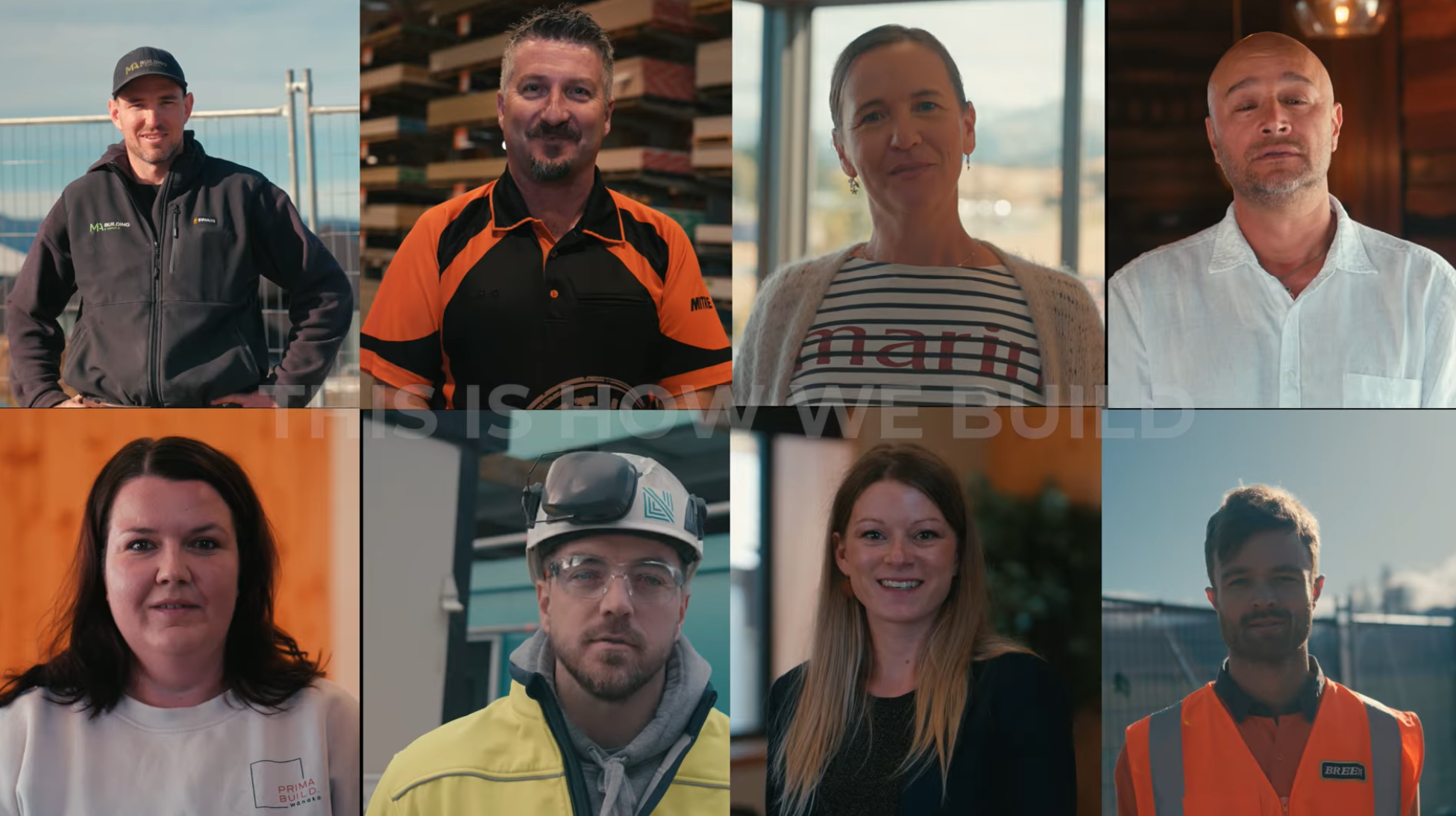
Integrated design is a collaborative approach to project planning and design that brings together key stakeholders early and throughout the design process to develop better building outcomes. While it can be implemented through a variety of methods and processes, the goal remains the same — to use collective expertise from the outset to identify opportunities, resolve challenges early, and optimise the build, performance, and sustainability.
Bringing stakeholders together early creates a shared understanding of project goals and values. Designers, engineers, builders, and others can align more quickly, identify potential issues before work begins, and reduce the likelihood of downstream design changes, rework, delays, and cost overruns. Put simply, it’s much easier (and cost effective) making changes to a build at the design phase than it is at any other stage.
Project optimisation also helps achieve sustainability outcomes by reducing resource consumption, waste, transportation requirements, emissions, and operational energy use.
Furthermore, early collaboration between key stakeholders can identify additional opportunities to design out waste, reduce embodied carbon, select lower-impact materials, enable circular economy strategies, and enhance building performance.
By identifying these opportunities early, they can be incorporated more effectively, helping to improve both project and environmental outcomes.
While integrated design approaches may be more common on larger commercial projects, its principles can still benefit projects of any size, including small one-off residential builds.
Traditional Design Process
In the traditional design process, the client typically engages a designer or design team to draft up and complete the project designs. Designs tend to be fully developed before other parties become involved.
This is sometimes referred to as the Design-Bid-Build Process, as contractors will bid on the project after designs are completed (see the 2019 Traditional Delivery Model - Information Sheet from the Government of New Zealand Procurement office).
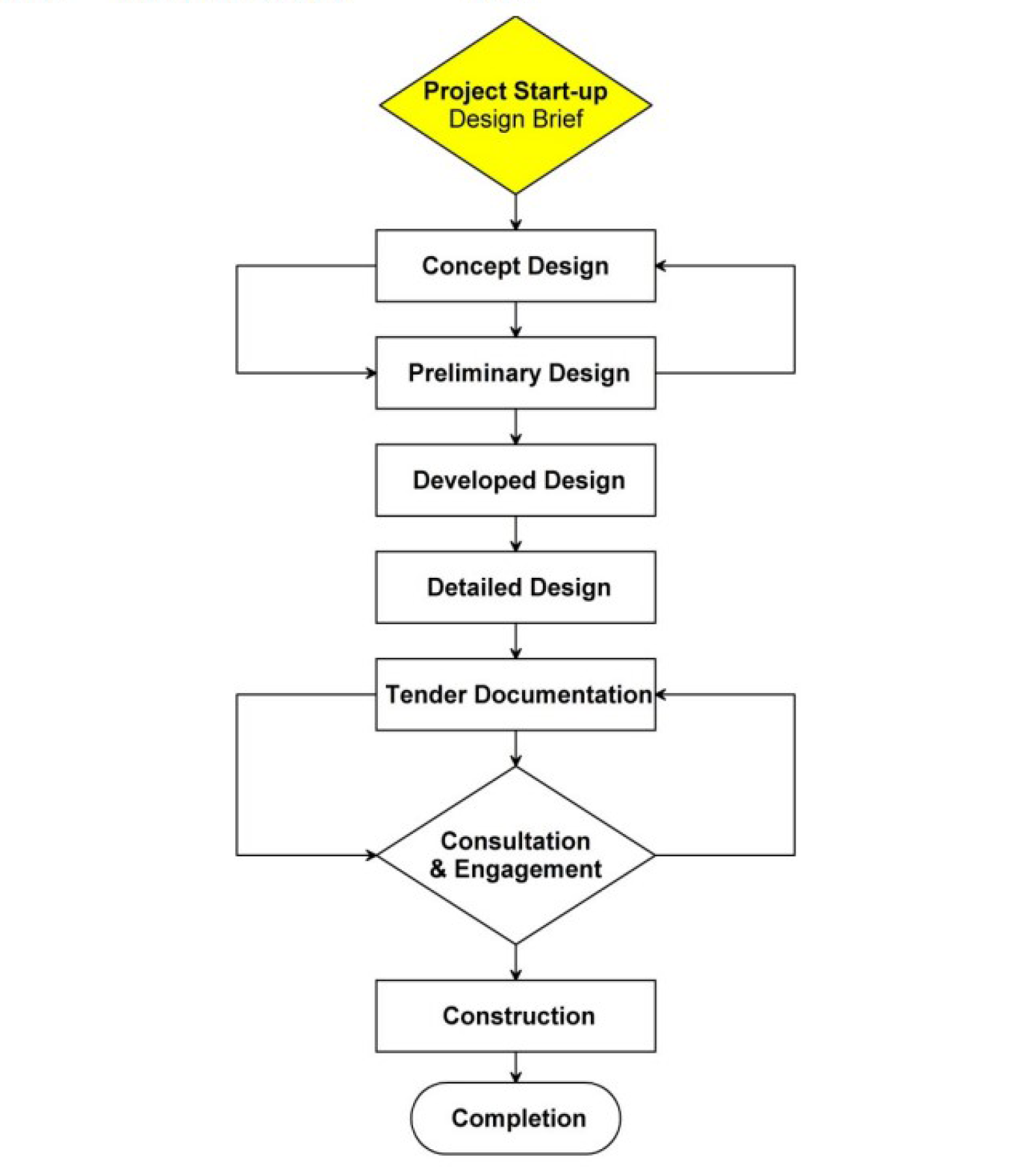
In the traditional process it’s common to see an eagerness to get a project finished as quickly and with as low a budget as possible. This thinking encourages a minimisation of time and energy spent at the early design phases, and with little involvement from other parties on the design input.
“The design team’s input peaks during detailed design and reduces during the construction phase and beyond. Optimisation is difficult using a conventional design approach, and problems may subsequently occur during the operational phase of the building,” according to the Ministry for the Environment’s Integrated whole building design guidelines.
Without collaboration between key project teams during the design stage, potential issues may not be identified until construction is underway, leading to costly rework, project delays, and unnecessary environmental impacts.
The New Zealand Government’s information sheet on the Traditional Delivery Model outlines several of these issues associated with the process.
While it may seem counterintuitive to spend more time and money at early design stages, it’s proven to increase the efficiency and optimisation of a project. Reducing overall time, fees, construction costs, supply-chain hold ups and an overrun on budget.
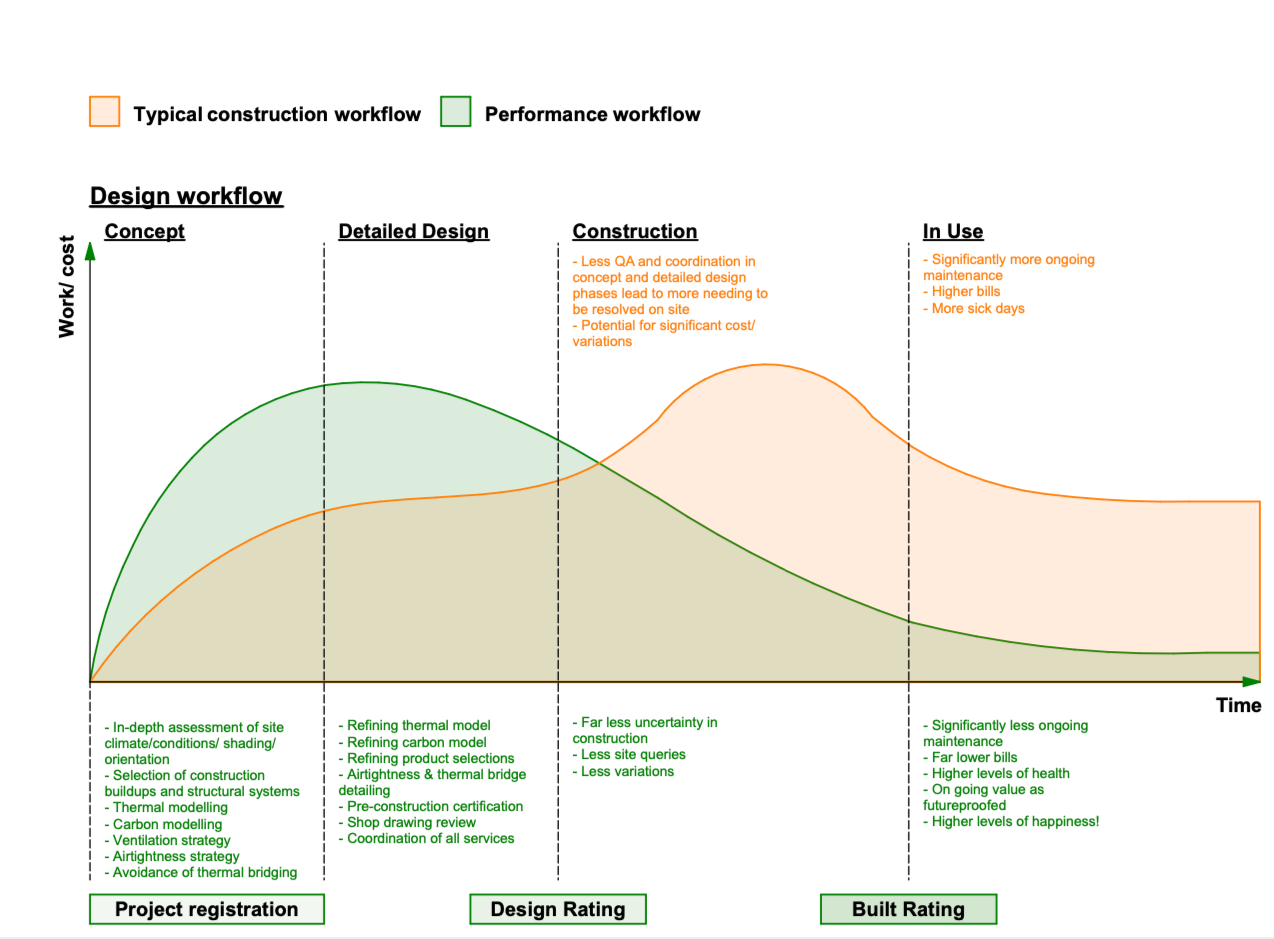
The above image highlights some of the benefits to implementing more time and energy at the design stage compared to traditional construction workflow.
Collaborative Design Models
Over the last few decades, several early stakeholder engagement approaches have emerged and gained traction within the building industry. There are some frameworks, such as the Living Building Challenge (LBC)that embed an integrated design approach into the building process right from the outset. To find out more about LBC, check out the resources below.
This module is going to focus on five of the more common approaches. The full Integrated Design Process (IDP) has been strongly promoted by multiple agencies. Other methodologies such as Early Contractor Involvement (ECI), Design and Build, Alliance Delivery Model, and Building Information Modelling (BIM) also fall within integrated design concepts.
Each method has its advantages and it’s important to understand each to see which will fit with your project. In all cases, with increased digitisation, the simple sharing of design plans and ideas with multiple stakeholders has become much easier. If you’re a client or someone at the early stages, it’s best to consider bringing in other parties earlier to help with decisions from the outset before decisions become more costly (financially and environmentally) later on.
The Integrated Design Process
The IDP has been developed and used for several decades. In the late 90’s the International Initiative for a Sustainable Built Environment released a report outlining the IDP:
“The IDP process contains no elements that are radically new, but integrates well-proven approaches into a systematic total process. The skills and experience of mechanical and electrical engineers, and those of more specialized consultants, can be integrated at the concept design level from the very beginning of the design process. When carried out in a spirit of cooperation among key actors, this results in a design that is highly efficient with minimal, and sometimes zero, incremental capital costs, along with reduced long-term operating and maintenance costs […] The IDP process is based on the well-proven observation that changes and improvements in any design process are relatively easy to make at the beginning of the process, but become increasingly difficult and disruptive as the process unfolds.”
Initially the primary focus for implementing IDP was to drive more energy efficient buildings or to improve “environmental performance”.
In New Zealand, the Ministry for the Environment released their own guidelines in 2008, which they called the Integrated Whole Building Design Process (IWBDP).
“The IWBDP is a design method which considers the building as a whole and requires the involvement of all stakeholders, design team members and future users or tenants. Integrated whole building design is a holistic, design-led approach that seeks to recognise the interconnectedness of a project’s goals.
Using this approach recognises that a building is by definition a ‛whole’ physical object, and behaves as a ‛whole’ dynamic system, both directly and indirectly with the natural world,” according to the Ministry for the Environment’s guidelines.
The IWBDP focuses on the benefits that collaborative efforts, like bringing all parties to the table, can have on a build. The table below shows the key differences between the IWBDP and the conventional design process.
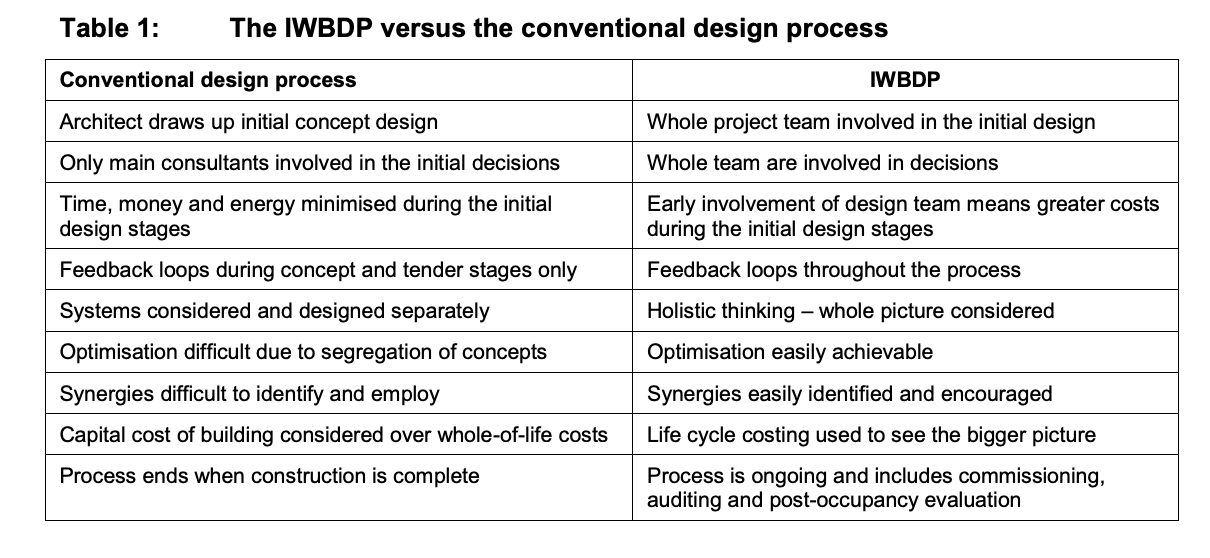
More recently, the Sustainable Business Network (SBN) released a guide titled Integrated Design Process in the Built Environment: Reduce Waste and Emissions | Increase Efficiency | Save Costs.
Not only does this guide outline how and why to pursue the IDP, but it also provides several New Zealand-based examples where the IDP or aspects of it have been utilised.
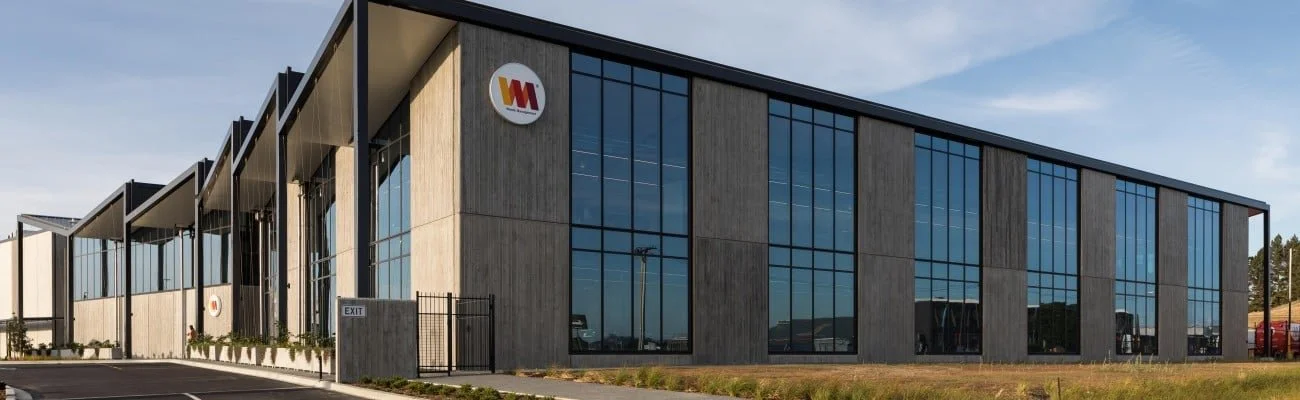
One of the projects highlighted was Waste Management’s new Auckland Head Office.
The build was completed in 2019 and won multiple awards and benefited greatly from the IDP. To read more about it, check out NZGBC’s case study.
While the concept of IDP has evolved over time, sustainable building outcomes have always been promoted. However, it’s only more recently that waste reduction has been included as a key outcome of IDP.
Waste reduction has typically only been addressed in later construction phases. However, it’s now understood that there’s much greater opportunity and effectiveness to reduce waste before it’s even created - at the design stage.
Through the collaborative efforts involved in the IDP, different teams can pool their expertise and specified knowledge to more effectively design out waste.
So, how is the IDP actually implemented?
Common methods include a series of workshops involving everyone. The first workshop is to align and set project goals before design even begins. It is this meeting where project goals and objectives are set. In the IWBDP this is called the “Visioning Workshop”, after which the design team will then create preliminary designs. These are then presented in a second collaborative workshop to help identify and resolve any issues – referred to as the “Focused Design Workshop”. In some cases a third workshop is held to further collaborate, and in most instances smaller sub-group workshops are held in between the all team workshops.
The Early Contractor Involvement (ECI)
While similar to the IDP, Early Contractor Involvement (ECI) is slightly different.
While the IDP’s key focus is a highly collaborative approach bringing all stakeholders together from the very beginning, ECI brings in the key contractor to work with the design team and help give design and buildability advice after concept and preliminary designs.
This approach allows the two teams to understand early on what is required in the build, any risks and opportunities for innovation, and provides value for money.
According to the New Zealand Government Procurement ECI guidelines, ECI is typically rolled out via a two stage tender process.
Where the first stage tender should already provide sufficient early design information, budget ceiling and pre-construction service agreement (PSA) information among other details, and the second “will involve the contractor working with the design team to provide input to the design and develop its tender price on an open-book basis in line with the PSA”.
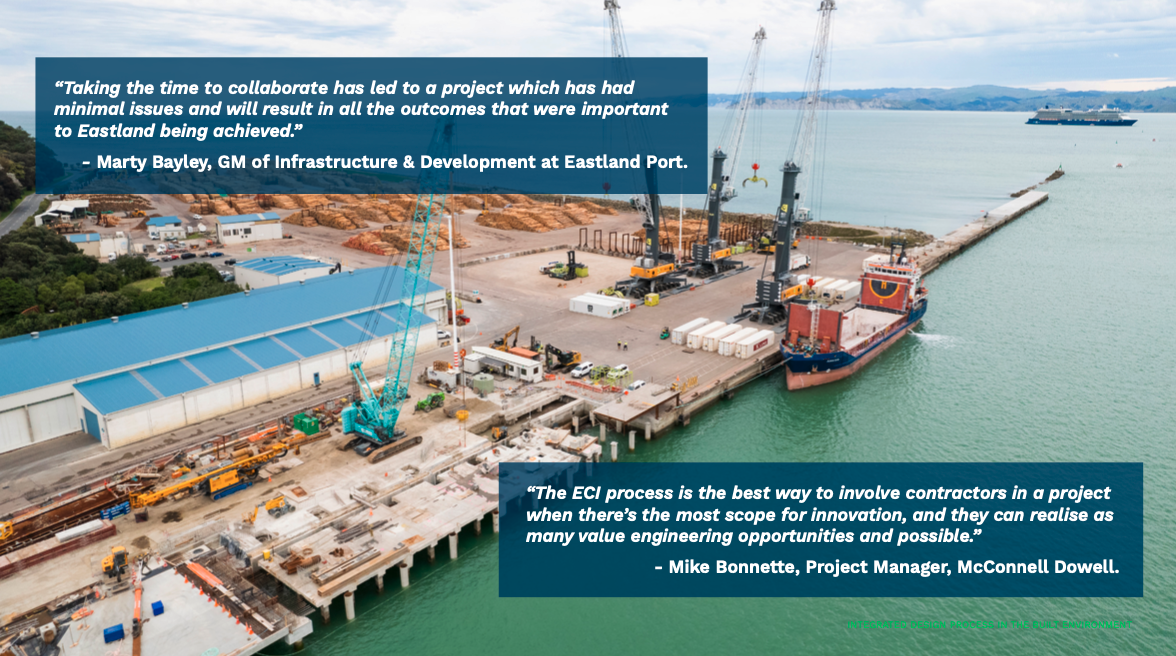
Gisborne’s Eastland Port Wharf 7 Rebuild Case Study - SBN Integrated Design Guidelines (pg. 7).
In the Gisborne Port example above, McConnell Dowell discovered risks early on with the retaining wall design, and in response provided in-depth details and estimates on an alternative deck-on-pile design during the tender stage.
Thanks to the ECI process, the client decided to follow the contractors suggestions, and even though a complete redesign was required it still reduced the cost, programme length, environmental impacts, and the carbon footprint of the project – a total of 13,692 tonnes of carbon dioxide equivalent were saved!
Design and Build Model
In the Design and Build delivery model, the main contractor takes on the responsibility for both the design and construction.
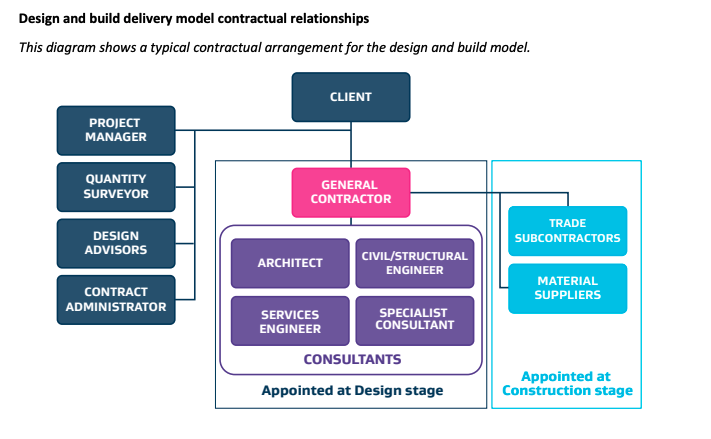
Design and Build Delivery Model Guideline - New Zealand Government Procurement
There are many benefits to the design and build process, including the integration of design between the contractor and design team. This integrated relationship can lead to innovative design solutions and faster project start and delivery timeframes.
However, it is worth noting that due to the contractual nature of the model, the design team’s primary obligation is to the contractor, and not the client.
Alliance Delivery Model
“The alliance delivery model is a relationship-style arrangement that brings together the client and one or more parties to work together to deliver the project, sharing project risks and rewards,” according to the New Zealand Government Procurement guideline on the Alliance Delivery Model.
Initially adopted in Australia and New Zealand, according to AECOM, the Alliance model is mostly used for large scale projects such as major infrastructure works.
A leading document in the field, The National Alliance Contracting Guidelines from the Australian Department of Infrastructure and Transport, explains that Alliance models function well for large scale projects that need quick start and finish times and where project and cost risks are not easily identifiable up front. The collective approach of multiple partners helps manage risks and produce better outcomes.
An excellent example of the alliance model being used in New Zealand is with the Stronger Christchurch Infrastructure Rebuild Team (SCIRT). Due to the complex project nature and need for quick turnaround after the Christchurch earthquakes, the alliance model proved highly successful.
Regarding the decision made by SCIRT for using the alliance model, “it was thought that other possible models, such as ‘Design and Construct’ or ‘Managed Contractor Model’, would not deliver with the speed required, would have complex administrative layers, and would not effectively bring together organisations with differing objectives”.
SCIRT realised several benefits through the alliance model, including:
reduced overheads;
streamlined approvals;
increased private sector participation;
reduce start-up times;
ahead of schedule finishes;
improved stakeholder relations and communication;
More locally, there’s the Whakatipu Transport Programme Alliance that’s currently delivering a host of projects across Queenstown. The project titled Kā Huanui a Tāhuna involves QLDC and Waka Kotahi NZ Transport Agency as key partners along with BECA, WSP, Downer New Zealand and Fulton Hogan as design and construction partners.
Using the alliance model, delivery partners work together from planning and design, all the way through to construction completion. In such an open-book type project, maintaining good relationships with all parties is key.
Building Information Modelling (BIM)
Building Information Modelling (BIM) is more than just a technological tool. Similar to the Integrated Design Process, BIM focuses on the holistic integration of all stakeholders in a project, but also combines modern technology to help advance project goals and better share and collaborate information across teams.
BIM is especially valuable in the early design stages, as it uses digital tools to help communicate design concepts more clearly to a wide range of stakeholders.
With the assistance from digitisation and software integration, information about the build is more easily shared, stored and updated. For example, multiple different teams (i.e. design, engineering, building) can all upload data in different formats. The technology will then be able to combine all the data into a single model, which can then be read in whichever way is easiest by each of the different parties.
The modern technology is carried through for the entire lifecycle of a building project, from pre-design to end-of-life, allowing all teams to engage and better understand the full project and outcomes.
As a result, all project stakeholders are able to engage more meaningfully and collaborate more effectively from the outset.
In addition to helping improve design decisions, it can also help with briefings, procurement, construction, handover and operation.
BIMinNZ is the leading organisation for promoting BIM in New Zealand. Their website shares helpful resources about BIM, including The New Zealand BIM Handbook. For a more simplified breakdown, check out the New Zealand Government Procurement BIM Guidelines.
Benefits and Challenges to Early Engagement
There’s a long list of potential benefits from engaging in the different integrated design approaches.
Stakeholders understand and are aware of project goals and objectives earlier on;
Stakeholders are more engaged and stimulated providing a better work atmosphere;
Project risks can be more easily identified and rectified;
Improved project designs are more easily realised; including more sustainable and/or cost effective options;
Fewer unexpected design changes at later stages of a project;
Improved constructability and construction quality;
Reduced programme and construction timelines;
Less project variations and/or rework; requiring less paperwork and government communication;
Improved site planning and construction sequencing;
Any duplication of efforts minimised;
More easily able to reduce waste through better design efforts;
Improved health and safety;
Improved site set up and on-site waste minimisation efforts;
Ability to more easily reduce embodied and operational carbon
Increase building’s energy efficiency and performance;
More easily realise effective and efficient building opportunities
In general, early stakeholder engagement provides the greatest value for a project by addressing needs up front, not later on when changes become increasingly difficult and costly. Having multiple stakeholders involved during the design stages helps improve build efficiency and better sustainability outcomes.
While the building industry is moving toward earlier and broader collaboration, New Zealand needs more of the industry to get on board.
Of course there are challenges to effectively implementing integrated design strategies.
One of the biggest challenges integrated design faces is getting buy-in from the client. Implementation of integrated design approaches are more likely when the client is aware of the strategies and its benefits.
From a client perspective, it’s easy to want to reduce costs by moving as quickly as possible to the build phase. However, the risks are a lower quality build, with more opportunities for errors, build disruptions and cost overruns.
Other challenges to be aware of when implementing integrated design strategies include:
Understanding roles and responsibilities from the offset;
Competitive or adversarial tensions;
Maintaining a no-blame culture;
Quality outcomes can be compromised in order to meet cost targets and time demands;
Most integrated design strategies require, or at least benefit from, one or more facilitators. Either someone brought in externally, or someone internally taking on the additional responsibilities;
An open-book and transparent mentality and way of working is required.
Other Note Worthy Design Concepts
As you can see, there’s no one “right” method. There are also other design based concepts that can help improve build quality and sustainability outcomes. Some of which include:
Designing out Waste
Modular and Prefabrication: Quicker build time, less errors, and reduces waste
Design for Disassembly: Can our buildings be designed to be disassembled or adapted. Deconstruction is not sustainable.
Life Cycle Assessments (LCA)
Energy Efficiency: By building more energy efficient buildings, we not only build healthier homes for healthier people, but we also help reduce operational carbon emissions.
Resources/Links
Integrated Design: Working Better Together to Build a Thriving, Future-Fit Aotearoa
Early Contractor Involvement or Design and Build - Cook Brothers Construction
BRANZ
NZGBC
Living Future Institute
Professional Development Points
Completing this training module is eligible for professional development points. To complete the module, make sure you have:
Read the webpage content
Checked out the links and resources on the page
Completed the quiz
Optional: watched the webinar for additional points
Licensed Building Practitioner Points:
Available to all participants. Log your points directly after completing the module — 1 hour of learning equals 1 LBP point. This module is estimated at 1 hour + an additional 1 hour if you watch the webinar.
Continuing Professional Development Points:
Available to NZIA members only. This module is eligible 10 CPD points, and an additional 10 points if you watch the webinar. Once you submit your quiz, we will notify NZIA.